History
Almost on the heels of Pineda, Cabeza de Vaca and his shipwrecked companions landed on the Texas coast, November 6, 1528. During 8 years of toil and hardship they made their way westward until they came to a frontier of civilization at Culiacan, Mexico. Many of their most interesting experiences occurred around Matagorda Bay. Of Caballo Pass, Cabeza de Vaca remarked that this inlet was a league wide and uniformly deep, and reminded him of Espiritu Santo Bay, as the mouth of the Mississippi was named on Pineda's map of 1519. WPA History, 1941 [Read more]
Mercantile & Manufacturing Firms, 1854
County Officials, 1880
County Officials, 1890
County Officials, 1894
SW Texas Graduates, 1904-1914
County Officials, 1910
County Officials, 1914
Texas A & M Students, 1917-1919
Medical Society Members, 1918-1919
County Officials, 1880
County Officials, 1890
County Officials, 1894
SW Texas Graduates, 1904-1914
County Officials, 1910
County Officials, 1914
Texas A & M Students, 1917-1919
Medical Society Members, 1918-1919
A series of county historical markers that give a short history of Indianola.
Other Historical Markers
La Salle Monument
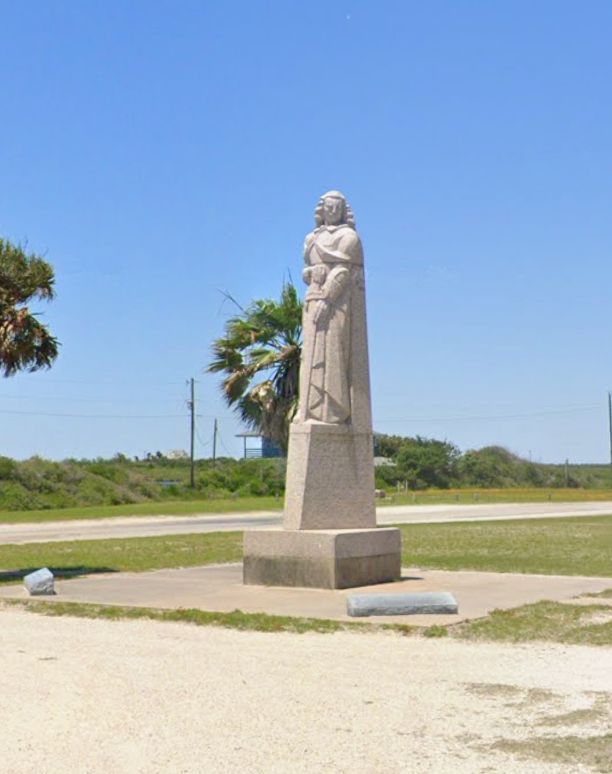
The 22-foot-tall Rene Robert Cavellier Sieur de La Salle Monument in Indianola, a major project of the 1936 Texas Centennial, is one of the most artistically-distinct products of the statewide celebration of Texas history. Sculptor Raoul Josset and architect Donald S. Nelson designed the memorial, one of 45 Centennial properties classified as a "monument," to commemorate the French explorer's landing place in Texas. Completed during the height of his career, Josset's hybrid high relief and full-rounded sculptural interpretation of La Salle is unique for its stylized composition compared to the bronze neo-Classical statues expected for the centenary. The scale and quality of La Salle are made more remarkable by its remote location on the Texas Gulf Coast. Carved in pink granite by master carver Ugo "Hugo" Lavaggi, the monument is the largest figurative sculpture produced for the statewide celebration. For two years, a controversy over property owner rights delayed and altered the original, modest plan until a statue of La Salle was awarded to Calhoun County in 1938. Dedicated the following year on a remote stretch of beach at La Salle's alleged 1685 landing point (later the port city of Indianola), it was the last commemorative monument erected for the Texas Centennial.
Source: Transcription from the document, National Register of Historic Places Registration Form, prepared by Bonnie Tipton Wilson on 1 November 2017; located on the website, Texas Historical Commission (http://thc.texas.gov), accessed on 20 July 2023.
The 22-foot-tall Rene Robert Cavellier Sieur de La Salle Monument in Indianola, a major project of the 1936 Texas Centennial, is one of the most artistically-distinct products of the statewide celebration of Texas history. Sculptor Raoul Josset and architect Donald S. Nelson designed the memorial, one of 45 Centennial properties classified as a "monument," to commemorate the French explorer's landing place in Texas. Completed during the height of his career, Josset's hybrid high relief and full-rounded sculptural interpretation of La Salle is unique for its stylized composition compared to the bronze neo-Classical statues expected for the centenary. The scale and quality of La Salle are made more remarkable by its remote location on the Texas Gulf Coast. Carved in pink granite by master carver Ugo "Hugo" Lavaggi, the monument is the largest figurative sculpture produced for the statewide celebration. For two years, a controversy over property owner rights delayed and altered the original, modest plan until a statue of La Salle was awarded to Calhoun County in 1938. Dedicated the following year on a remote stretch of beach at La Salle's alleged 1685 landing point (later the port city of Indianola), it was the last commemorative monument erected for the Texas Centennial.
Source: Transcription from the document, National Register of Historic Places Registration Form, prepared by Bonnie Tipton Wilson on 1 November 2017; located on the website, Texas Historical Commission (http://thc.texas.gov), accessed on 20 July 2023.
Matagorda Island Lighthouse
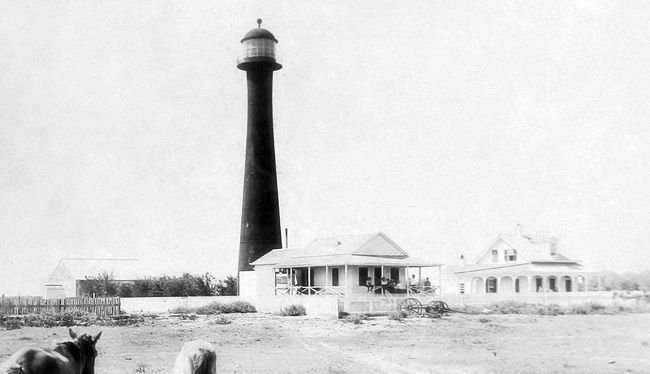
The Matagorda Lighthouse is significant because it is the first lighthouse built on Matagorda Bay. It was built in 1852, a 79 foot tower was in place, stationing the Third Order lens 96 feet above sea level. It was constructed on cast-iron. The tower had a unique color scheme for the Gulf Coast, with black, red and white horizontal bands. The revolving light, showing a flash every 90 seconds, was visible for 16 miles.
The Rebels attempted to blow the cast-iron tower up but only several plates were broken. In 1865, the Rebels stole the lens and clockwork from the tower. Due to neglect during the Civil War, the sea eroded the tower and it had to be dismantled in 1876 to prevent its collapse. The lens and clockwork were recovered and placed in the present tower built with its original cast-iron.
The lighthouse board decided that a light similar to that at Bolivar Point in Galveston Bay should be erected. After considerable delay in acquiring the site, the light was rebuilt by July 1873, on the west side of Pass Cavallo, two miles from the original site.
Lighted on September 1, 1873, the lantern showed a flash every 90 seconds from 91 feet above sea level.
On August 19-20, 1886, a "Severe storm raged at this station. The water rose to an unusual height and stood some four feet deep in the tower." The storm swept away everything on the station grounds except the tower itself, and the keeper's quarter.
There were calm days, too. On October 12, 1918, it was calm and not a bit of air, and the bugs got so thick that they obscured the light. The next morning, the keeper climbed the spiral staircase armed with a shovel to scoop the dead insects from the lantern and gallery.
The light is still in full use, on the west side of Pass Cavallo, visible for 25 miles to sea. The paint scheme is now black.
Source: Transcription from the document, National Register of Historic Places Registration Form, prepared by R. J. Barker on 17 April 1978; located on the website, Texas Historical Commission (http://thc.texas.gov), accessed on 20 July 2023.
The Matagorda Lighthouse is significant because it is the first lighthouse built on Matagorda Bay. It was built in 1852, a 79 foot tower was in place, stationing the Third Order lens 96 feet above sea level. It was constructed on cast-iron. The tower had a unique color scheme for the Gulf Coast, with black, red and white horizontal bands. The revolving light, showing a flash every 90 seconds, was visible for 16 miles.
The Rebels attempted to blow the cast-iron tower up but only several plates were broken. In 1865, the Rebels stole the lens and clockwork from the tower. Due to neglect during the Civil War, the sea eroded the tower and it had to be dismantled in 1876 to prevent its collapse. The lens and clockwork were recovered and placed in the present tower built with its original cast-iron.
The lighthouse board decided that a light similar to that at Bolivar Point in Galveston Bay should be erected. After considerable delay in acquiring the site, the light was rebuilt by July 1873, on the west side of Pass Cavallo, two miles from the original site.
Lighted on September 1, 1873, the lantern showed a flash every 90 seconds from 91 feet above sea level.
On August 19-20, 1886, a "Severe storm raged at this station. The water rose to an unusual height and stood some four feet deep in the tower." The storm swept away everything on the station grounds except the tower itself, and the keeper's quarter.
There were calm days, too. On October 12, 1918, it was calm and not a bit of air, and the bugs got so thick that they obscured the light. The next morning, the keeper climbed the spiral staircase armed with a shovel to scoop the dead insects from the lantern and gallery.
The light is still in full use, on the west side of Pass Cavallo, visible for 25 miles to sea. The paint scheme is now black.
Source: Transcription from the document, National Register of Historic Places Registration Form, prepared by R. J. Barker on 17 April 1978; located on the website, Texas Historical Commission (http://thc.texas.gov), accessed on 20 July 2023.