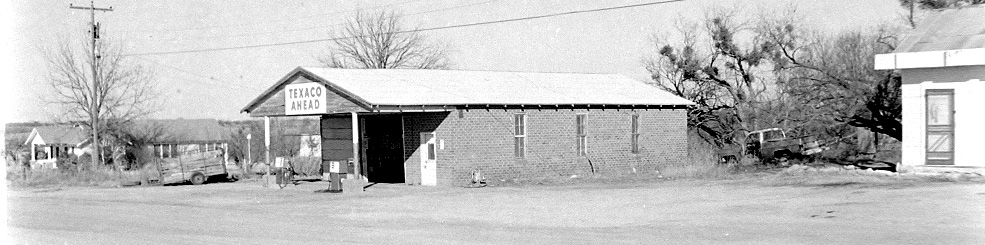
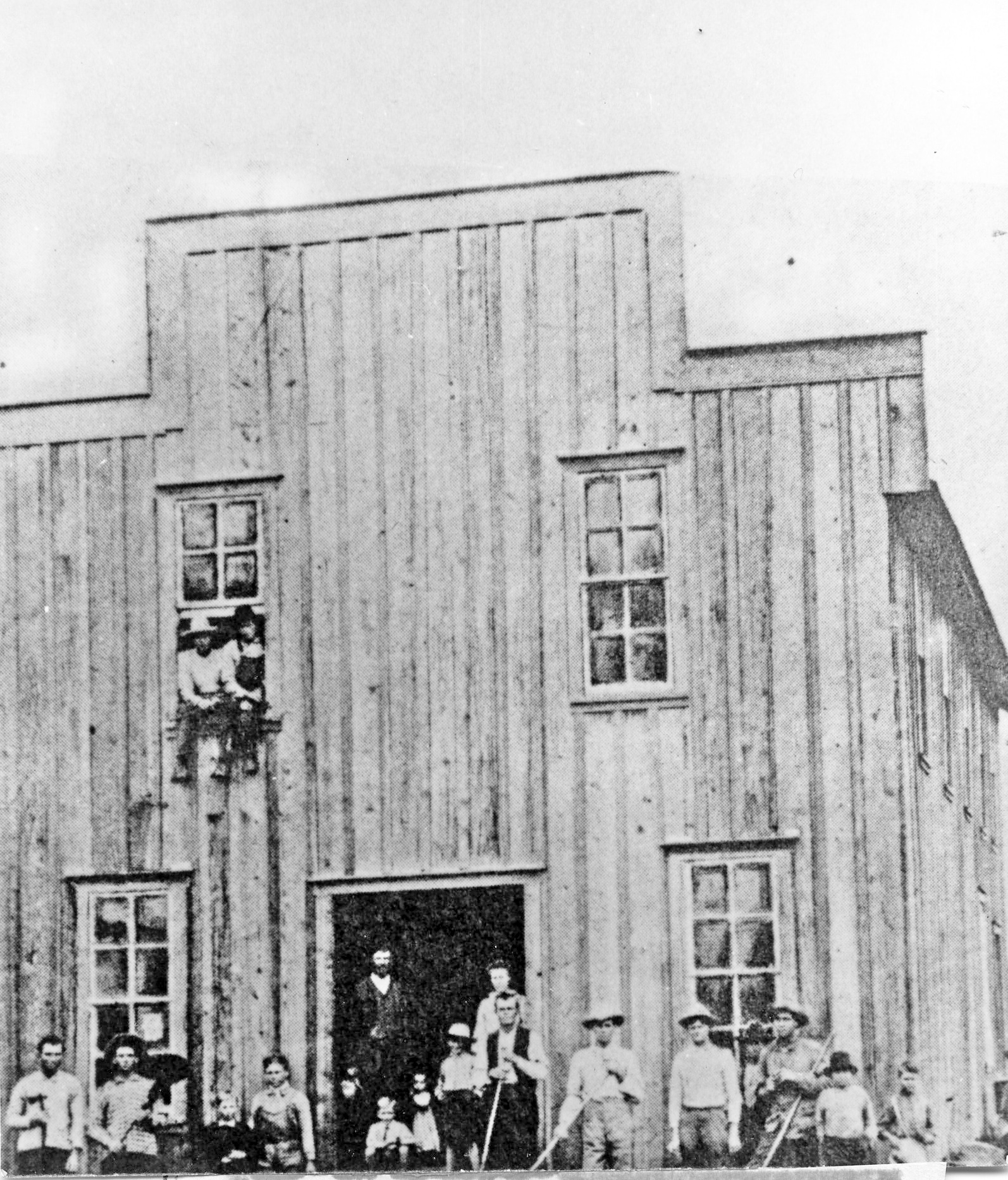
Early Trickham
[taken from “Into the Setting
Sun” by Beatrice Grady Gay, 1936]
The first town
settled in the county was Trickham.
It is in the extreme southeastern part of
the county, on the line of John Chisum’s
old cattle trail, near its entrance into
the county. It is hard to determine
just when the first little store was put
in down on Mukewater, but it was sometime
during the late eighteen-fifties, and most
probably about the time Camp Colorado was
established there. One authority
tells us that “John Chisum started a
little store down on Mukewater about a
mile below the army post for the
convenience of his trail drivers.”
His brother-in-law, Emory Peters, who had
a crippled hand, ran the store with the
help of a man named Bill Franks.
George Teague was bookkeeper at Chisum’s
store. In those days the nearest
bank was in Austin. Mr. Chisum
always carried his money in a wallet hung
on the horn of his saddle. According
to Dick Fiveash, “John Chisum would send
Franks to Austin after money to pay off
his men, and Franks would return with his
saddlebags full of gold and silver; or he
would be sent to Austin with the money
received from the sale of a herd of
cattle, to be placed in the bank.”
|
John Chisum never lived in Coleman
County, but for a number of years
maintained his store at Trickham
and a ranch headquarters on Home
Creek; also a series of corrals in
this and nearby counties for aid
in the distribution of his cattle,
which ranged from the Concho down
the Colorado over all the southern
part of the county, and remained
there until 1867, when he went on
up into Lincoln County, New
Mexico, where the range was less
crowded and he could have the
valleys of the Pecos for his
herds.
In May 1874, John Chisum sold his
store at Triekham to L. L. Shield,
who came into Coleman County from
Hunt County. Mr. Shield
enlarged the old building, which
for so long had been the center of
all activities in that part of the
county, into one of generous
proportions, in which he installed
a general mercantile business, the
first of its kind in the
county. Mr. Shield also
bought cattle and marketed them
for a number of years.
|
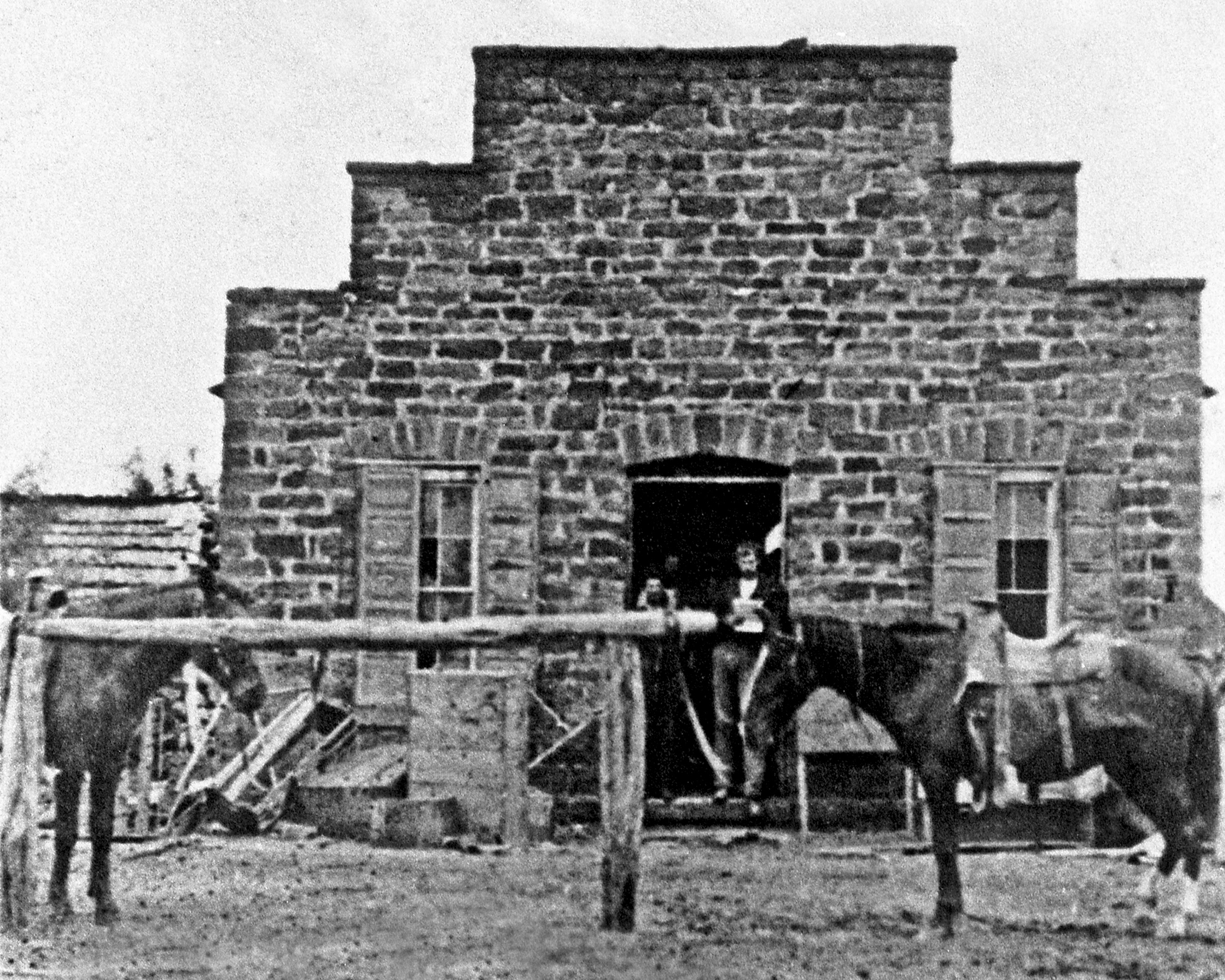
L. L. Shield Store, 1870s
|
The history of the
earliest development of Trickham is told
by Dick Fiveash. “I was born in
Erath County in 1862 and moved with my
parents to Coleman County in 1864.
We settled on Mukewater about a mile south
of where Trickham is now. My father
built a log cabin to live in. There
were very few people in the county at that
time and my uncle, Bill Williams, and his
family, who came with us, were our only
neighbors. My Uncle Bill, who was a
real pioneer, became known all over the
county as “Mukewater Bill.” He had
lots of fights with the Indians and owned
a bridle which was made out of the hide of
an Indian he had killed. “There was
lots of wild game in the county when we
first came, and a long while after.
I’ve seen the valleys of the creek black
with buffalo plenty of times, and we could
always find deer and turkeys. We had
to go to Austin after our flour and it
cost $20.00 a barrel. It generally
took us two weeks to make the trip.
My cousin, Lot Ellington, had come to live
with us and help with the cattle. We
also had a man named Tom Moss. My
father sent Lot Ellington to Ft. Worth
after supplies and somewhere he was
exposed to smallpox. Soon after he
got back he took it and died. Then
all the family took it from him. My
father and mother both died and so did Tom
Moss. Everyone was afraid to come
near enough to do anything for us, since
in those days, in 1876, doctors didn’t
know much about treating smallpox or
vaccinating against it. Dr. Edwards
at Brownwood was the only doctor we
knew. He came and looked in at the
door and when he saw how terribly bad it
was, he turned and went back home without
doing anything at all for us.
“There was a young
Dr. Page at Brownwood then who had been
there only a short while, a friend of the
Grady and Cheatham families, who had all
come from Kentucky. When Dr. Page
heard about what Dr. Edwards had done he
got on his horse and came out to see about
us, and stayed with us ‘til the disease
had run its course. Dr. Page had
been vaccinated and he had a light case of
varioloid, but soon got over it.
When my father and mother died, no one
could be found to help the doctor prepare
them for burial. They were wrapped
in blankets and buried at night. The
people did dig the graves, but they didn’t
help fill them up. Charlie Shield,
brother of Lee Shield, helped dig the
graves and kept them from digging one for
me, as I was not expected to live.
“I saw why the three
men were killed by Indians at Trickham,
Dave Upton, Jake Dofflemeier, and Charlie
McCain. They were all scalped and a
green mesquite stick had been punched
through their noses. The first one
was Charlie McCain, about sixteen years
old. He was out with his father,
Brunson McCain, after a load of wood when
a bunch of eight or ten Indians ran onto
them. Mr. McCain cut the horses
loose from the wagon and put Charlie on
one of them, telling him to run. The
Indians followed, killed the boy, and took
the horses. Then they went on and
didn’t bother anybody else. Dave
Upton lived up on Camp Creek (a small
tributary of Hay Creek) near where the
Rendleman place is now. One day he
was out in the woods and discovered a
small band of Indians. He didn’t
think they saw him, so he started on a run
to Trickham to warn the people to put up
their horses. The Indians started
after him, as they had probably seen him
first, soon overtook, killed, and scalped
him, and threw his body in the
brush. They stripped him also and
carried off his clothes. Jake
Dofflemeier also lived up the creek from
Trickham. He had a fine horse of
racing stock of which he was very
proud. Everybody around knew the
horse. The morning he was out
looking for his horse he ran onto a small
band of Indians out after horses,
too. They killed and scalped Mr.
Dofflemeier and rode on through Trickham,
where the horse was recognized.”
Mrs.
George
Green, now living in Coleman, tells us
that her grandfather, L. J. Tankersley, U.
S. Army man, and companion, Mr. Carmine,
Ranger, from Comanche, were killed by
Indians at Trickham, and are buried
there. Mrs. Tankersley always told
her family in telling of those perilous
days on the frontier that there was never
any danger from the wandering Indian
tribes. The trouble was caused by
the marauding bands. These men were
buried where the town of Trickham grew up
around them, the
first
and
last buried at that place. The
graves are unmarked, but a wall about 1
1/2 feet high of flat sand rocks is built
over each. The Fiveash family was
buried out to the west of Trickham about
half a mile. Charlie Ellington was
also killed by the Indians.
Trickham - 1900’s
by Mrs. Irene Mclver [Bobo]
Durham
On October 14th,
1883, a petition was filed with the Grand
Lodge of Texas for a lodge at Trickham,
Texas. This petition was approved on
December 8th, 1883. A dispensation
was granted on December 15, 1883 and
District Deputy McConnall set Sam Houston
Lodge to work. Rev. J. C. S. Baird
was Master of the lodge, W. D. Watson was
Senior Warden and John C. Jones was Junior
Warden. Sam Houston Lodge No. 597
was officially chartered on December 12,
1884. Among the early members were
W. D. Mathews, Mose Waters, H. Volentine,
B. C. Hardin, E. P. James, C. F. Shield,
W. F. Stacy, P. Himmins, M. R. Cheatham,
J. L. Vaughn, W. B. Hunter and many other
early settlers. As with most early
lodges, Sam Houston Lodge No. 597 met in
the top floor of a building and the lower
floor was used as a school and on Sundays,
a church. This lodge demised in
1894.
Trickham led in
another field also, having been known
throughout the country for its good
singers, quartets, singing conventions,
etc. This interest developed early
because of song leaders in the Sunday
School and church contributing their
efforts. Some of this roster
contains names like Jack Mulhis, Edmund
Laswell, Tom Stacy, Homer Goodgion, Ceo.
W. Bobo, Walter Stacy, A. J. Martin,
Albert Dean and, more recently, Joe
Stacy. Many of us recall the singing
schools as early as 1908 or sooner, taught
by Edmund Laswehl and Aud Myrick, where we
learned our notes in music, which gave us
the necessary skills to become singers,
song leaders and organists or
pianists. Ceo. W. Bobo, song leader,
singing school teacher and songwriter for
the Vaughn, Stamps and other music
companies, came into the community in the
early teens and was instrumental in
creating a further interest in
music. He was able to direct
quartets and to bring in singers of the
highest quality to singings and big
conventions from these music companies,
keeping the people here in touch with the
best caliber in the field of sacred music.
Excitement ran high
when Trickham won another first, which was
an oil well. About the year 1908,
the first oil well in Coleman County came
in on Vaughn land southwest of Trickham,
and we all flocked to the scene to see
it. Then, following that, about 1910
to 1912, an oil-drilling crew from Humble,
Texas, came to Trickham to drill for
oil. This crew of four or more men
built a little shack in the middle of
Trickham where they lived while drilling a
well south of Trickham on Vaughn
land. It resulted in the Hot Wells
that were popular for so long. But
here, Cupid entered in. Three of
them dated Trickham belles of prominent
families, which resulted in one marriage,
and of course this couple moved
away. It was as late as about 1930
when Trickham began to use natural gas in
the businesses and homes which came from a
gas well two or more miles west of
Trickham.
The telephone came
early to Trickham. There was a means
of communication in the L. E. Page Store
as early as 1903, used for emergencies to
Santa Anna. Then, probably by 1906,
Mr. Kilgore had run a line on wire fences
from Winchell across to the Gill Ranch
southwest of Trickham where there was a
telephone switchboard or exchange.
Then followed the same pattern on wire
fences to Trickham. The telephone
exchanges in Trickham were always located
in homes where the family there would
operate it. Among the families
running the telephone company here were Ed
and Ruth Limroth, Homer and Katie
Lawrence, Lev and Mamie Lawrence and the
A. J. Martin family. Since then
Trickham is served by the Coleman County
Telephone Co-Op.
What could be
considered the first doctor, at least
performing a doctor’s duties, was a
midwife, Mrs. McElwreath, called Grandma
McElwreath. This woman of such
indomitable strength and vision, who came
from Georgia by the mid-1870s, was
instrumental in bringing many of us into
the world who were born before or after
the turn of the century. Her work
was carried on until through 1908 at
least, and then other doctors came
in. Dr. Seitz lived in Trickham
during the first decade when there was a
drug store run by Mr. and Mrs. Eugene
Wilson, who also had the post office in
that building at that time. By 1910,
Dr. Sonendriker was a physician in
Trickham. Dr. Lyon and Dr. Boone
were also doctors in Trickham.
Early in the century
Trickham had a variety of businesses
lining “Main Street.” Just to the
north of it and to one side, and of great
importance, was a blacksmith shop.
Before 1910, it was owned and operated by
Mr. Tommy Harrison. Then after that
the following owned and ran it: Mr. Frank
Rucker and Mr. Gid Matthews; Mr. Frank
Rucker and Mr. Ord Harrison; and Mr.
Drury. Another blacksmith shop later
was located on the south side of Main
Street run by Mr. O. V. (Pete) Mitchell
followed by Mr. Clyde Haynes and Mr. Tom
Bingham. These last two left an
unusual sign on the site of the
shop. One of these blacksmiths was a
justice of the peace and a notary.
Thus the sign indicates the services
available - justice of the peace, a
notary, also could do ox-welding and
offered “matrimonial services.”
The cotton gin was
another basic ingredient in the early
economy of Trickham. The first gin
was located near the creek and northeast
of the main center of things before 1900
and was run by Mr. Burge. The
location after that was always just east
down Main Street toward the creek.
It was owned and run by Mr. Ed Bartlett
and last by Mr. Jake Walters.
Then the two stores
on the south side of the street were a
large store run by Mr. Obe Smith and son
Dave, and one run by Mr. Willie
Bailey. A two-story building on the
north side of the street was the Tom Stacy
Store - later run by Mr. Rodgers. To
the west of it was the drugstore, barber
shop, by Johnny Volentine and Mr. L. E.
Page ‘s store. But at the west end of the
street was a large general store - the
Lawrence Store. This was later
bought by Jim Matthews in the early
teens. The wide range of merchandise
that could be bought on this street ranged
from dress material to horse collars to
kerosene
The
Tom Stacy Store about 1900
|
Beginning
with the 1940’s and a little earlier,
consolidation of schools was one step
toward the beginning of the end of such
rural communities. This, coupled
with the war years when people went
elsewhere to work, all contributed to the
demise of this once bustling community,
changing the lifestyle of its
citizens. Finally, with the closing
of the post office in 1979, run by Mrs.
Minnie Wilson, and the closing about two
years earlier of the last store, run by
Leston Cozart, leaves the Martin Dairy as
the only remaining business. The
Texas Almanac shows an area population of
Trickham to be 12 in 1980.
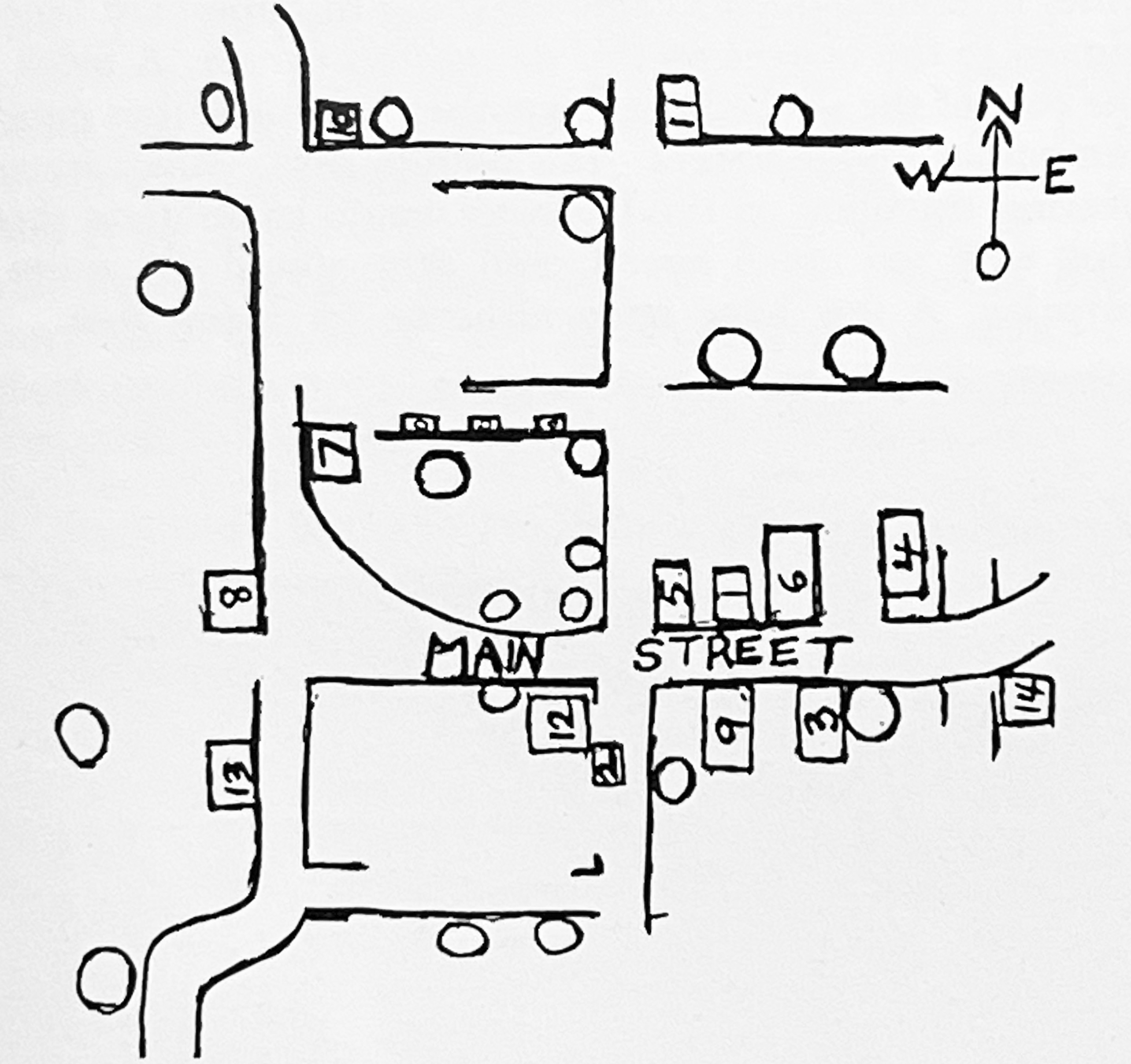
Map of Trickham, from Irene
Durham
|
Residences: Marked with circles
Public Buildings: marked with a
square
Graves of Pioneers: marked with a circle inside
a square
1. Drug Store and Post Office
2. Telephone Exchange
3. Willie Bailey Store
4. Blacksmith Shop
5. L.E. Page Store
6. Tom Stacy Store
7. Church
8. Union Church
9. Obe Smith Store
10. Church
11. Shield Rock Store
12. Lawrence Store
13. School
14. Gin
|
|