


OUR TRIP TO THE GULF COAST
By Mrs. R. T. Moore, Liberty, Neb.
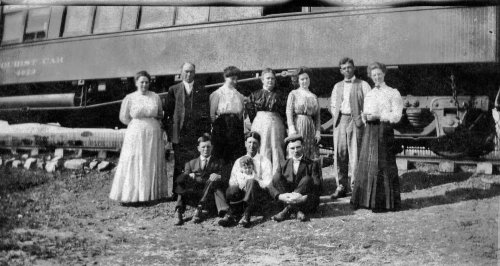 One
of the most enjoyable trips it has been our pleasure to take was the recent
one to the Gulf Coast of Texas in Company with about eighteen or twenty
from here. We were furnished a Pullman car at Liberty and provided with
a porter. At Kansas City we joined the International Land & Investment Co’s
special train, made up of like parties from many states as far east and
including Pennsylvania, with dining cars attached and the journey to the
South Land continued in earnest. For twenty fours we rode through Kansas
and Oklahoma, and daylight Thursday morning found us crossing Red River,
the boundary line, and Gainsville is our first stop in Texas. One of the
first things to attract our attention is the exclusive use by the railroads
of oil burning engines to pull their trains. From the traveler’s view this
is a decided improvement over the objectionable smoke and cinders one has
constantly to endure on all the coal burning roads. Many of us for the first
time see a cotton field, with men, women and children patiently gathering
the white treasure and filling the long pillow shaped bags suspended from
one shoulder and dragging several feet behind them. This is the last picking
and is thin and scattering. We are told it takes three pickings, each about
a month apart, to gather the entire crop, and that the first picking which
is the heavist, makes a beautiful sight—almost solid white.
One
of the most enjoyable trips it has been our pleasure to take was the recent
one to the Gulf Coast of Texas in Company with about eighteen or twenty
from here. We were furnished a Pullman car at Liberty and provided with
a porter. At Kansas City we joined the International Land & Investment Co’s
special train, made up of like parties from many states as far east and
including Pennsylvania, with dining cars attached and the journey to the
South Land continued in earnest. For twenty fours we rode through Kansas
and Oklahoma, and daylight Thursday morning found us crossing Red River,
the boundary line, and Gainsville is our first stop in Texas. One of the
first things to attract our attention is the exclusive use by the railroads
of oil burning engines to pull their trains. From the traveler’s view this
is a decided improvement over the objectionable smoke and cinders one has
constantly to endure on all the coal burning roads. Many of us for the first
time see a cotton field, with men, women and children patiently gathering
the white treasure and filling the long pillow shaped bags suspended from
one shoulder and dragging several feet behind them. This is the last picking
and is thin and scattering. We are told it takes three pickings, each about
a month apart, to gather the entire crop, and that the first picking which
is the heavist, makes a beautiful sight—almost solid white.
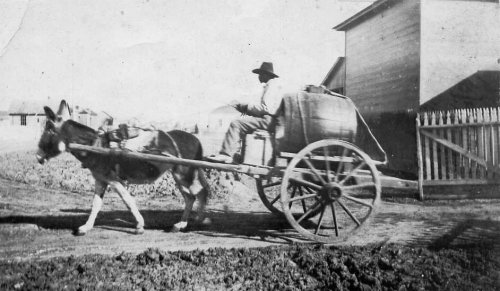 The
small mule is here in evidence, being used almost entirely for all kinds
of farm work, and for that matter I would say for almost all other purposes,
as we see very few horses even in the towns. The inevitable cotton gin is
everywhere, no town seems to be too small or remote to possess one, and
you soon get to expect them as you do to see cribs and elevators along the
railroads in the corn belt. We pass many miles of freight cars of all descriptions
pressed into service, and all loaded with cotton and bound for Galveston.
All day we ride through this almost monotonous and never ending chain of
cotton fields, broken only now and then by streams skirted with uncertain
growth of timber.
The
small mule is here in evidence, being used almost entirely for all kinds
of farm work, and for that matter I would say for almost all other purposes,
as we see very few horses even in the towns. The inevitable cotton gin is
everywhere, no town seems to be too small or remote to possess one, and
you soon get to expect them as you do to see cribs and elevators along the
railroads in the corn belt. We pass many miles of freight cars of all descriptions
pressed into service, and all loaded with cotton and bound for Galveston.
All day we ride through this almost monotonous and never ending chain of
cotton fields, broken only now and then by streams skirted with uncertain
growth of timber.
Fort Worth, Cleburne, Temple and Milano and other prosperous looking towns are passed and night finds us only half way across the great state. Friday morning at Beeville we find ourselves in a country of tropical appearance, and as our train stops here for some minutes we proceed to investigate: We find the date palm, orange, lemon and banana. The bananas, however, are ornamental and not grown in a commercial way, for we are not far enough south to escape frosts. Here is grown the large sugar yams so delicious in flavor and richness.
As we proceed south the absence of the negro is noted, and the ever roaming families of Mexicans take their place. We are told the Mexicans and negroes do not get along well together.
The country is now assuming a flat appearance and the soil grows darker. The scattering growth of cactus and mesquite gives the country a desolate look and as the train glides swiftly along we wonder what the cattle can find to picking in this tangle of thorns.
Passing quickly to the clearings of the Taft tract the scene is reversed, and where three years ago stood the cactus and brush, now lays broad fields of cotton as level as the floor, convincing the most prejudiced that the possibilities of this country are large, and the development of its resources is yet in its infancy. The growing season is almost continuous, cotton and other crops are planted in February. Winter vegetables, cabbage, etc., are being planted now and something is being harvested or ready for market most every month in the year. Our train was pulled through the Taft farms as far as Gregory. Here the Southworth family left us for their new home near Robstown, bearing the good wishes of all that they might find health and prosperity in that country of promise, and we are confident they will for we find ourselves rapidly becoming enthusiastic over the possibilities of this country. Before leaving Gregory we were taken through the large tourists hotel which is modern in all its appointments, and while the town is not yet half the size of Liberty the hotel would do credit to Beatrice. At the town of Taft we stopped long enough to go through the packing-house and cotton gin. At Sinton we find a string of carriages and the ever-present mule team, waiting for us.
As we start out along the road we half-way feel that we are sort of a circus parade, and in fact some of our crowd are already acting like clowns and monkeys for everyone is bent on having a big time. In the outskirts of town we go through a large orange grove. These trees are only two and three years old, and many of them are bearing, the fruit however is still green, and does not ripen until later. West of Sinton we pass through a sandy strip about a mile wide; this is the melon and vegetable land.
About one hundred cars of melons were shipped from Sinton this past summer, commanding the highest price in the northern markets as they are the first on the market. Our drive takes us through the lands that have been thrown open during the last three years, and while some of it is still in brush, a great deal is already under cultivation and with improvements of a substantial character. We pass a large country school, and learn that it is located on one corner of the farm owned by one townsman, Mr. Geo. Sutter.
We soon pass to the lands now being sold by the company. It is what they call hog wallow, and the mesquite is of rather heavier growth than some we passed through. All interested parties and prospective buyers are provided with maps. The prices range from $30 to $50 per acre depending entirely upon distance from town. The buying don’t seem to drag, and many acres are sold in an hour’s time. Some buy only a forty or an 80, while others buy several hundred acres. It is dark when we get back to our cars and the night air is already chilly though the day has been warm. Our train has been side tracked at the new town of St. Paul, where we spend the night. This town is mostly on paper yet, however a $12,000 hotel is half completed, and a large lumber yard, store, livery barn and several other buildings are done, two public parks are laid out, and the prospects bright for a good town. Saturday the sale of land is continued and we learn that the Company’s sales for the two days were something over $100,000.
Some of our party being anxious to see more of Sinton went over on the early morning train and spent the day there. Sinton has been a town so far as name is concerned for many years. It is the county seat of San Patricio county and consisted of nothing much but the courthouse until these lands began to be opened up about three years ago. Since then its growth has been rapid and substantial. The business houses are modern and all lines seemingly well represented. Several large hotels, a large ice plant, and a cotton compress now under construction, are among the things worthy of mention in this thriving town of fifteen hundred people.
Within a radius of a few miles of Sinton, Liberty people own nearly a thousand acres of land which when planted to cotton yields from one-half to one bale to the acre, worth at the present price about seventy dollars per bale. The seed pays a large part of picking and ginning. At Robstown a few miles to the south one Nebraska farmer sold 27 bales from 37 acres of this season’s picking, netting him above all expenses a little more than fifteen hundred dollars. A Mr. Oliver of near here told us of fifteen acres of alfalfa he has from which he has already had four cuttings averaging more than a ton to the acre, and the present price is high, being about twenty dollars per ton.
Our train pulled into Corpus Christi Saturday evening. This is one of the oldest towns along the Gulf, and is beautifully situated on the cliffs skirting the bay bearing its name. Like many old towns its streets are narrow and irregular and the buildings low and flat. But these faults are fast disappearing. The streets are being widened and the buildings of the last few years are thoroughly modern, some of the banks being models of beauty and the better class of retail stores in all lines compare favorably with northern towns of five times the size. It is a tourist’s town, and its floating population must be nearly equal to its permanent residents—for the furnish-rooms and furnished cottages signs stare at you on every street and in all directions.
The beautiful Oleander here grows to the dimensions of a tree, filling the yards and walks with their fragrance and shade. The Tropical Palm and Umbrella trees are in every year, and the quaint Salt Cedars, reminding one of the dwarfed trees of Japan, are seen near the water. The markets were full of fresh vegetables such as we only have a few weeks in the spring and early summer.
The trip across the bay to Aransas Pass is one to be remembered for a long time. We ply the captain with more questions than the average four-year-old, but he evidently is accustomed to it for he doesn’t seem to tire of entertaining us. He tells us the names of all the different waterfowl, and we watch them at close range, for they are not afraid. The sea gull sweeps gracefully around us. The long-legged crane stalks majestically about in shallow water, looking for all the world like some pompous person who knows it all. The hawk drops like a rock from the cloudless sky and is almost buried in the water, and as it rises we see a fish squirming in its talons. We see porpoise as large as horses sporting in the water not far away, and they seem as playful as kittens.
We reach the Pass just as dinner is ready, and we are ready too. It is ready, and we are ready too. It is a typical fish and oyster dinner with all you want and plenty to spare. The dinner consisted of three courses: catching the fish, cooking the fish, and eating the fish. Our party put in their time on the third course. You can catch your own fish and have it cooked while you wait if you choose. Those fish-dressers are experts. While some of us would be getting our fish off the hook, and perhaps getting the hook in our fingers several times in the operation, they would have theirs scaled, cleaned, dressed and ready for the frying pan.
After dinner we walked out to the Government jetties and looked wise as though we understood it all—harbors, dredging, etc., are of little interest to the average feminine intellect, especially when the beach is strewn with beautiful shells. When it was time to return some of us had to ask help to get our shells back to the boat.
An automobile trip around town and into the surrounding country was another one of the attractive features of our few days in Corpus, and made us feel that it must be a pleasant place to live.
The return trip north was without particular incident save that we encountered a snowstorm the first day of our return, which was a rather abrupt change from the cotton fields, orange groves and summer bathing of a few days previous.
Our crowd was indeed a congenial one, consisting of Mr. and Mrs. E. M. Copeland, Mr. and Mrs. E. A. Adams, Mr. and Mrs. R. T. Moore, Mr. and Mrs. D. W. Martin, Will Johnson, Will Morris and Henry Southworth and family, of Liberty, L. A. White of Lincoln and several others from this part of Nebraska.
We wish to thank Mr. John H. Shary, president of the company, who made possible this pleasant and inexpensive trip, Mr. Harry Montgomery, car manager, for the excellent service on the cars and also to Mr. L. A. White, for the attention he gave our crowd, which added much to its pleasure and comfort.
It was truly a grand trip from every standpoint.
(The above trip was made October 18-27, 1910.)
This article was printed by Dan Martin in the Liberty Journal
newspaper.
Submitted by: Martin Weaver

