Trinidad
United Methodist Church Established 1902
History
prepared by Cleora Wright Fleming
Prepared
in 1983
In the early 1700s, John Wesley, a member of the Church
of England, founded a new Protestant group called the
United Society. Critics believed the sect to be too
orderly or methodical and called its members Methodists.
Wesley, not knowing he was starting a new religion, liked
and adopted the name. He had begun the Society as a part
of the Church of England, feeling a need for moral
strictness. As he traveled and preached, he made no
attempt to organize his followers into a single body or
to separate them from the Church of England. Many
clergymen accepted the new doctrines and took part in
Wesley’s work. He appointed lay preachers to help
carry on his work. The Church of England refused to
accept some of the results of Wesley’s work and also
refused to recognize his preachers. In the mid 1700s the
Society became a separate denomination, although Wesley
himself never left the Church of England. In England the
main body was called the Wesleyan Methodist Church and in
about 1770 sent missionaries to America. [The Methodist
Church was not officially organized in England until
after 1784.] At a conference in Baltimore in 1784, they
created a formal church organization and adopted the name
of Methodist Episcopal Church. The church grew rapidly.
In 1843, because of the question of slavery, a group
withdrew from the Church and formed the Wesleyan
Methodist Church. The following year the main body split
because of the same issue. The southern members broke
away to form the Methodist Episcopal Church South. Still
another division was the Free Methodist Church. Three
Methodist denominations have been organized for Negroes
– the African Methodist Episcopal Church, the
African Methodist Church Zion, and Christian Methodist
Episcopal Church. There had been a long and determined
effort to join all these groups into one organization. In
1939, a plan of union was adopted by a uniting conference
of the various churches. The Methodist Church was formed
from a combination of the Methodist Episcopal Church, the
Methodist Protestant Church, and the Methodist Episcopal
Church South. The government of the Methodist Church in
America is Episcopal, which means that it is organized
with bishops at its head. A plan of union was made
effective by the Uniting Conference in Dallas, Texas on
April 23, 1968, which united the Methodist Church with
the Evangelical United Brethren Church, becoming the
United Methodist Church. This union embodied the history
and traditions of many churches which are Methodist in
name or tradition.
In September 1833, Rev James P Stephenson organized a
“Religious Society” at the home of Colonel
Samuel McMahan, near San Augustine, Texas. In July 1834,
under the leadership of Rev Henry Stephenson, this
society reorganized as a Methodist Church and when a
building was completer in 1839 by the Rev Littleton
Fowler, it was given the name of McMahan’s Chapel.
It is known as the oldest Methodist Church having
continuous existence in Texas and is located five and
one-half miles west of Geneva, Sabine County, Texas. No
record can be found of a Methodist Church being organized
earlier in Texas. [There were other churches organized
about this time that no longer exist.]
At a session of the Texas Conference at Henderson, Texas
in 1848, a new district was made, called “Trinity
District”, and was composed of the territory north
of Houston County to the Red River on the north, and back
west to the Trinity River – three counties wide.
Henderson County was taken into this new district, its
distances being 1800 miles in circumstance. Rev J W Felds
was placed in charge of this new district for which he
was paid $139.00 per year. He wore out one good mule
valued at $300.00 and two horses worth $100.00 each. At
the end of the year he went to give his report a walking
skeleton, broken down in health and spirit. His Bishop
proposed to give him an easier place, but Rev Felds
replied he had come to Texas as a missionary and proposed
to stay and fight it out. After deliberation, the
District was cut down and Rev Felds was made a Presiding
Elder of the Palestine District where his life was more
comfortable.
This devout old minister was an inspiration to Hezekiah
Mitcham. Mitcham had received his Botanic
Physician’s license on March 4, 1836 from the
Friendly Botanic Society in Claiborne, Clarke County,
Alabama. He engaged in the practice of medicine for a
time but becoming convinced the medicines were all a
humbug, he began expounding the Gospel. He was the first
resident minister in Henderson County. He often told his
daughter-in-law, Mrs James A Mitcham, that he preached
his first sermon in Athens and that it was to a
congregation gathered under the old oak tree near the
courthouse square. In 1852, he organized a Methodist
Church. Services were held at various locations and in
surrounding communities.
In the fall of 1854, in the small settlement known as
Caney Creek, after their crops were in, Rev Hezehiah
Mitcham and his followers erected what is believed to be
the first Methodist Church to be built in Henderson
County. The location, on a half acre of land situated on
the Jane Irvine Survey, was donated by the pastor’s
son, James A Mitcham. The church was made of logs chinked
with mud. Its native rock fireplace had a mud-in-stick
chimney. Benches were handdressed split logs. It came to
be known as Mitcham Chapel Methodist Episcopal Church
South and the community of Caney Creek came to be known
as Mitcham Chapel.
In 1883, the General Minutes of the Methodist Episcopal
Church South lists Rev Neil Brown as the pastor to serve
the Malakoff Circuit of the Tyler District, East Texas
Conference. This is the first listing of Malakoff as a
pastoral appointment in the District. In 1890, the
General Minutes lists Malakoff on a circuit with Athens.
In 1895, the pastoral appointments show the Rev N I Brown
was the first pastor of the “Malakoff Station”.
It was at this time that Malakoff became a half station
with several other churches, including Trinidad and
Walnut Creek.
Older settlers and members of the church tell us about
Methodists attending church at the Airheart Ferry that
crossed the Trinity River near the cemetery.
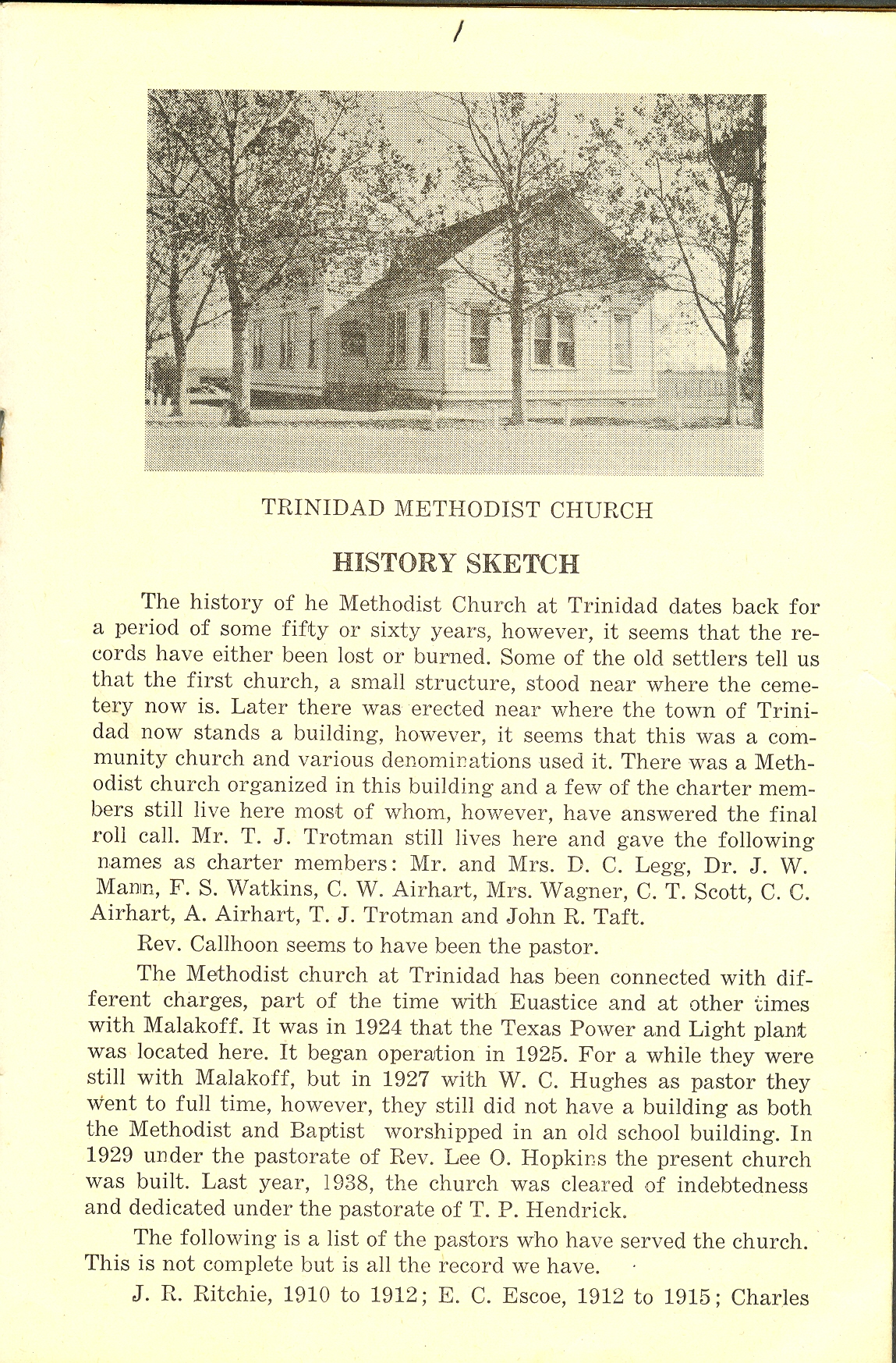
In 1888, D C Legg donated land for the church in
Trinidad. It was built by Jacob Henry Smalling, but the
year is not recorded.
It was used, not only for a church, but also for a school
for resident children. In the 1980s, some of our older
members, Alice Wright, Alpine Holcomb, Helen French,
Lillian Smith, Tommy Stanfield, Otis Stanfield, Byron
Jackson, and Edna Harkins remember attending the church.
Lanterns were placed on fence posts outside the church
for night services. The building was located on Legg
Street. There was a bell that was tolled for services.
Although the community was sparsely populated, people
came in wagons with their children to attend services.
Members used the well and outhouse (owned by Mrs Lula
Hammet) located near the church.
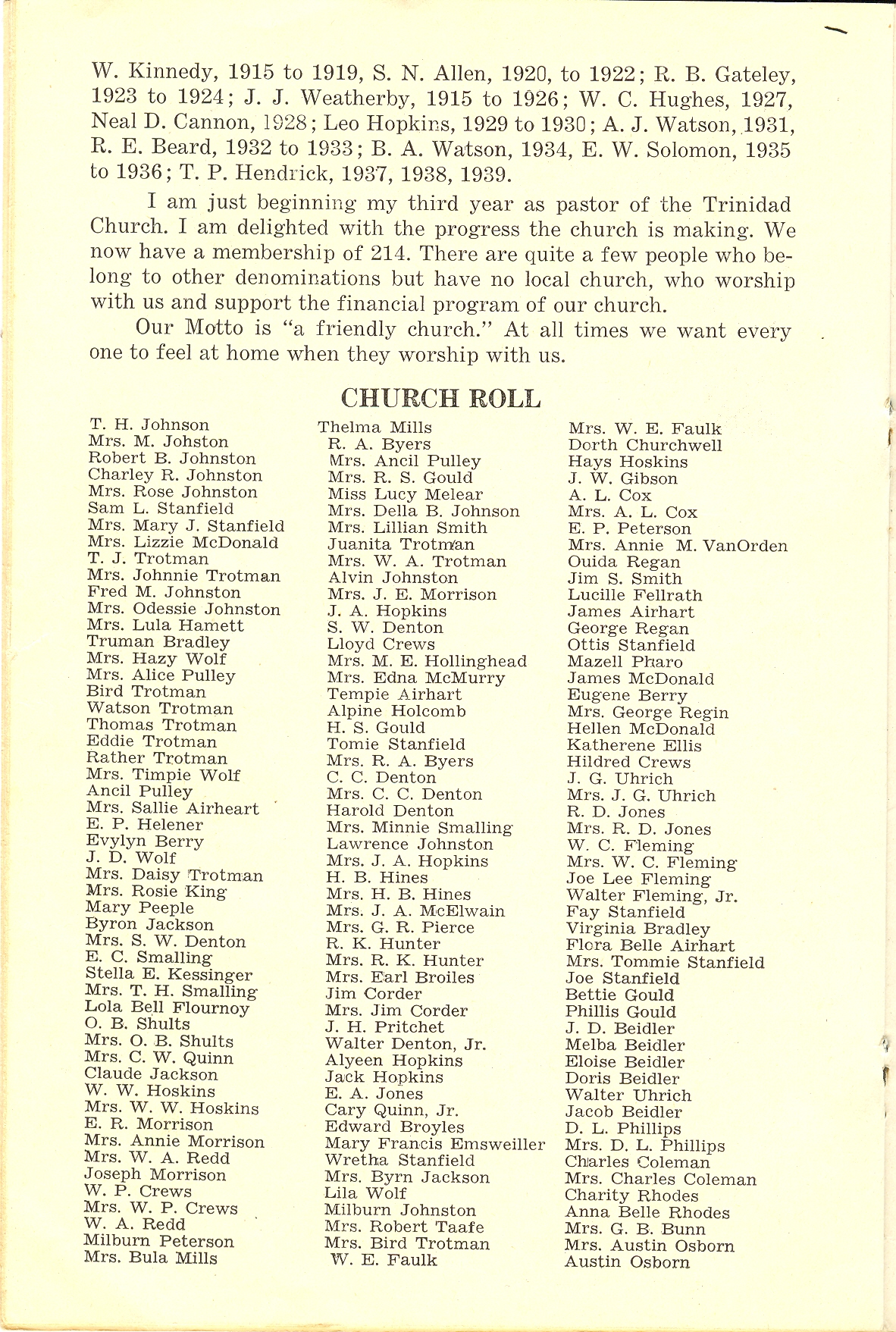
Charter members of the Methodist Church in Trinidad in
1902 included D C Legg, T J Trotman, Mrs D C Legg, Dr J W
Mann, F S Watkins, C W Airheart, Mrs Wagner, C T Scott, C
C Airheart, John R Tafee. All were Methodists except the
two Airhearts, who were Baptists.
In 1907, Trinidad was transferred from the Tyler District
to the Jacksonville District. Later, in 1948, it was
transferred to the Palestine District. [It is now (2007)
in the Northwest District.]
Trinidad Methodist Episcopal South record books begin
with Rev L Pormer as Pastor, year not recorded. There
were 78 members listed. The first dated records begin in
October 1910 with Bishop Myron and Presiding Elder Thomas
A Smith.
In 1912-1915, E C Escoe was Pastor with the same Bishop
and Presiding Elder.
In 1928, services were held in an old movie house with a
board walk to protect members from deep mud. The late Mrs
Allen Hopkins was Sunday School teacher. The church was
located where the present day City Hall stands.
In 1924, Texas Power & Light Company located a plant
in Trinidad and began operation in 1926. The increased
population led to the construction of a new building.
[That building was replaced in 1983]
Rev W C Hughes chose the Trinidad Circuit and was a
full-time pastor in 1927. The old “Pierce Home”
was rented as a parsonage. The house still remains today,
located on Oak Street.
D C Legg donated land at 221 McEntire Street for the
building. In April 1929, trustees were given the green
light for construction.
Under the pastorate of Lee
Hopkins the church was built. Carpenters were Allen
Hopkins, Charlie Johnston, and members of the church.
The Epworth League was organized
in 1927, with 28 members.
In 1928, a Home Department was
organized by Mrs J B Poindexter, who served as President.
In April 1929, the Adult Home
League Department was organized under the charge of Mrs
Ancil Pulley.
In April 1930, members moved into
the new building. It was financed in part by the trustees
borrowing $2,000 from the Texas Board of Church
Extension. Cost of the building was $4,000. Through
generous gifts and the hard work of the membership,
$1,600 had been paid by the time it was occupied.
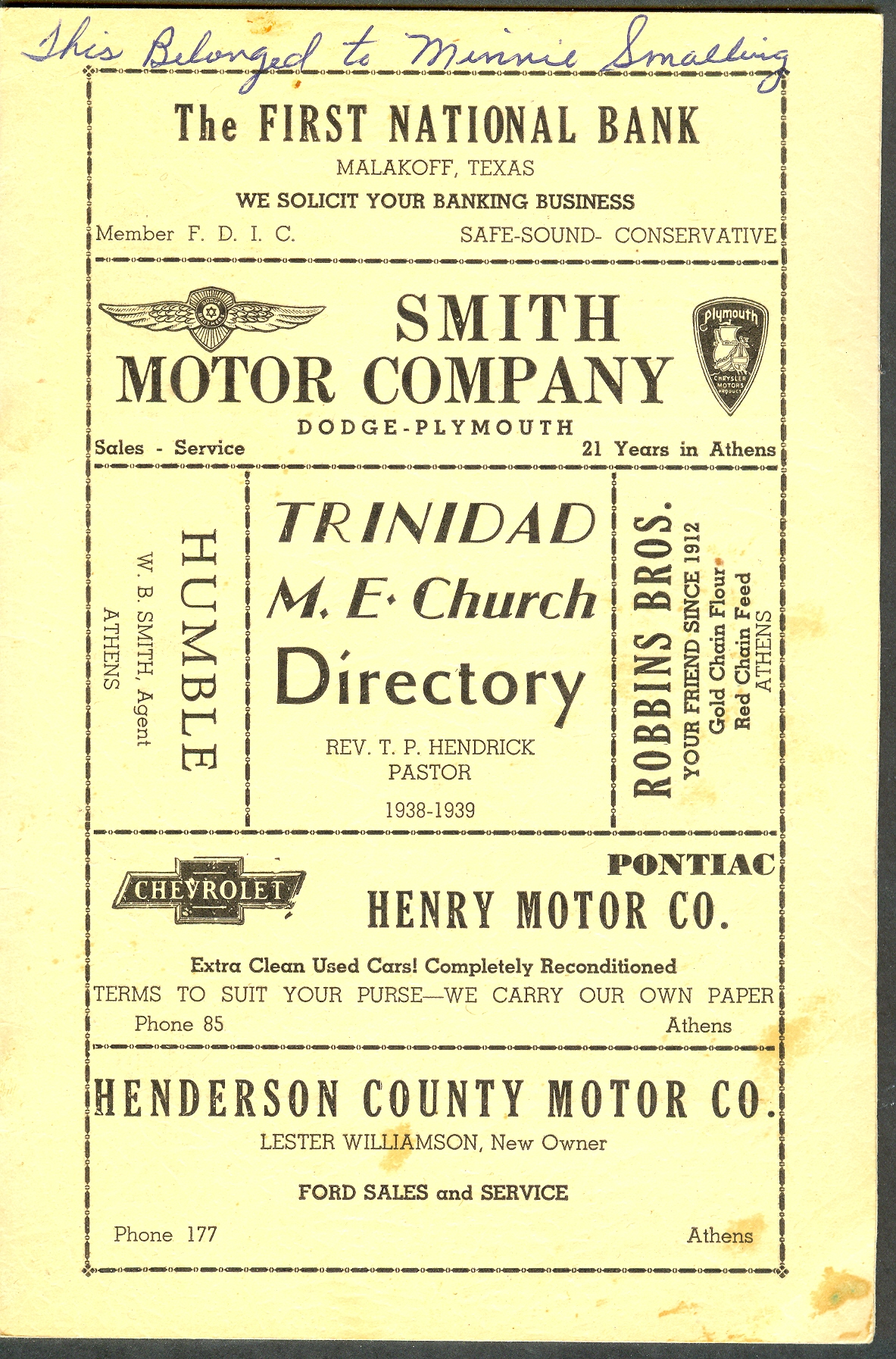
The building was cleared of
indebtedness and dedicated in 1938 during the pastorate T
P Hendricks as Pastor. He served 1937-1939.
Other pastors serving during the
time it was paid for included Leo Hopkins, A J Watson, R
E Beard, B A Watson, and E W Solomon.
In September 1932, members built
a parsonage. Land, located at 860 McEntire, was donated
by Dr and Mrs Ancil Pulley.
Trustees borrowed $300 from the
conference and placed a lien on the building to borrow
$700 more. The parsonage was used until 1968. The
property was then valued at $1,300.
The Senior Epworth League was
reorganized in January 1934, by Mrs Ruth Hunter as
sponsor. A young people’s department in this league
was sponsored by Alvin Johnston.
In August 1934, new wooden seats
were placed in the church. The same month new hymnals
were bought.
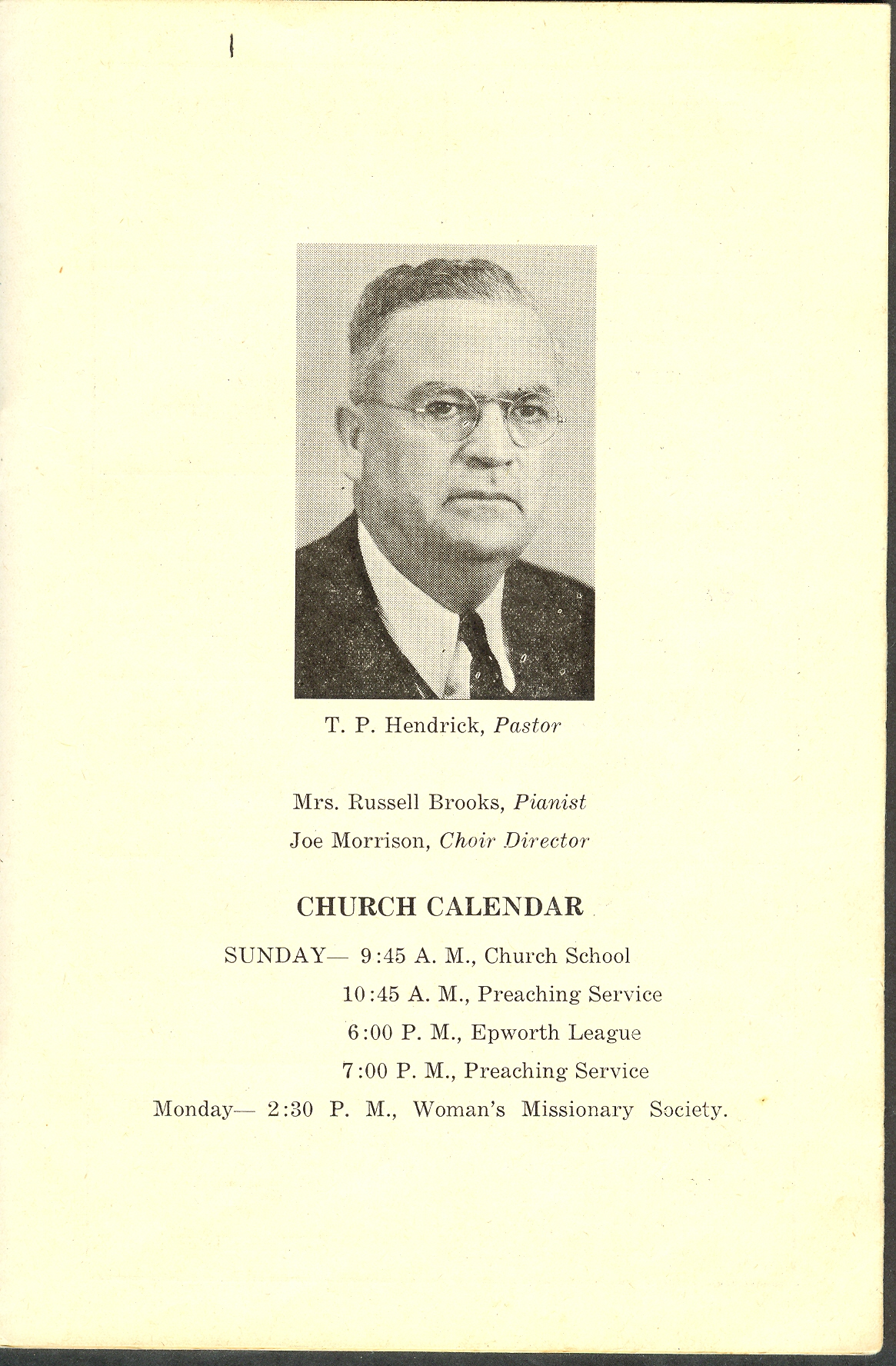
At that time, 1939, Mrs Russell
Brooks was pianist, Joe Morrison was choir director, and
the total membership was 214.
The church calendar included
Sunday School at 9:45AM; preaching at 10:45AM; Epworth
League at 6PM; preaching at 7PM; and the Women’s
Missionary Society on Mondays at 2:30PM.
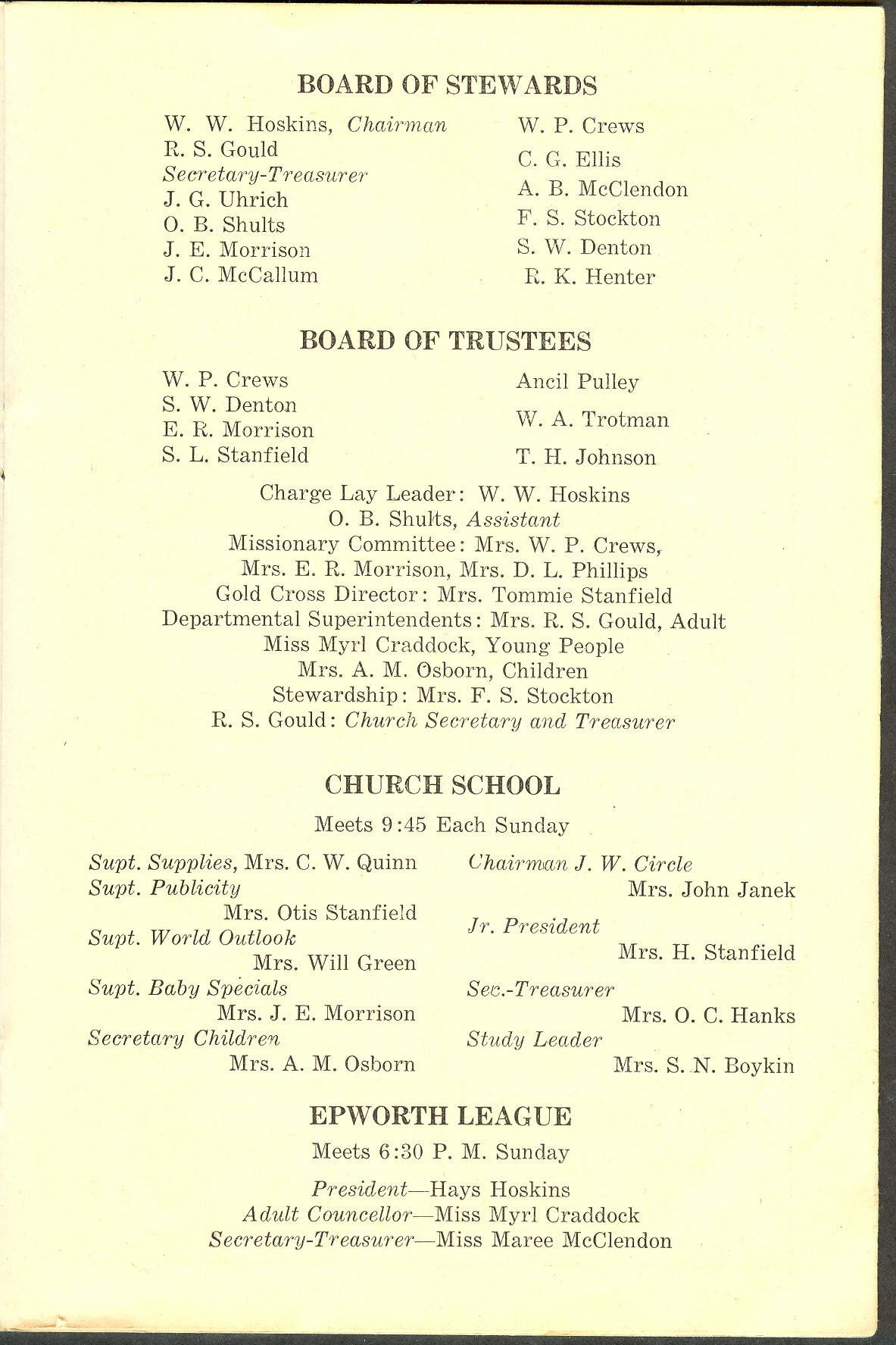
The Board of Stewards consisted
of W W Hoskins at chairman, R S Gould, J G Uhrich, O B
Shults, E R Morrison, J C McCallum, W P Crews, C G Ellis,
A B McClendon, F S Stockton, S W Denton, and R K Hunter.
The Board of Trustees was made up
of W P Crews, S W Denton, E R Morrison, Sam Stanfield,
Ancil Pulley, W A Trotman, and T H Johnston.
New pews were bought from
Sam’s Furniture in Waco by the Ladies Dorcus Sunday
School Class in 1943. These were placed in the church
under the pastorate of Rev Jesse Robertson. [These pews
were moved to the new sanctuary when it was built, and
are still in use]
The Dorcas Class purchased an
attic fan for the church and had it installed in July
1947. They also helped buy a new septic tank and commode
for the parsonage.
Under the pastorate of Rev E J
Davis Sr – in 1953 – a meeting of church
members was held on Monday night. It was voted almost
unanimously in favor of the construction of a new
Educational Building to provide a needed kitchen, rest
rooms, class rooms, and a nursery.
At that time, members had an out
house, no inside plumbing, a small kitchen where the
present storeroom is now located.
Practically 50% of the
approximated $7,500 needed for the proposed project was
subscribed at the first meeting.
Claude Jackson and Lawton Parks
were carpenters. Much of the labor was donated.
Different class members bought
dishes for the kitchen. Gleaners and the Couples Class
members put the stoves in the kitchen and helped lay the
tile in the Educational Building. Chairs were bought by
members.
Pew cushions were bought under
Rev E J Davis in 1957 at a cost of $540.
In 1960, under Bill Bailey, the
sanctuary was air-conditioned. In 1962-1962, the
Educational Building was air-conditioned. This occurred
under the pastorate of Rev Wayne Cannon. The Lions Club
met in the Educational Building for their monthly night
meals. The ladies from the Gleaners Class, Couples Class,
and Dorcas Class would prepare their meals, and were paid
nominal fees. This money was used to help pay for many
things in the Educational Building and kitchen.
In April 1965, four lots were
purchased behind the existing church building for $600
each. They were for future use for a parsonage and church
buildings.
In June 1965, donations were made
for new hymnals.
In May 1968, work was underway to
build a new parsonage. The old parsonage was sold and
funds from that sale were used toward the cost of the new
house. There was also $8,034 in the Building Fund to use
toward total costs. Those funds were left to the church
by the late Mrs Neil.
Chester McEntire was employed as
carpenter for the construction. The slab was poured July
25,1968.
A lot of labor was donated. Bob
Eaton built the kitchen cabinets, Milburn Johnston,
assisted by his wife Mary Ellen, and Ann Rounsavall
painted the house.
The Gleaners Class took care of
the furnishing of the new parsonage.
Actual cost of the house was
$13,500. It was valued at that time at $23,500.
Furnishings, estimated at $6,000, brought the total value
to $28,500.
Under the pastorate of Buford
Finley, the church sanctuary was repainted. Milburn
Johnston directed and gave a lot of labor. Jim Williams,
Tommy Stanfield, Buford Finley, Bill Freeman, Mrs Alice
Wright, and Cleora Fleming helped a lot in this project.
In 1970, choir robes were
purchased by the sale of a Methodist Cookbook. These sold
for $2.00 each. Mrs Mary Ellen Johnston, organist, and
treasurer of the choir, borrowed $279 from the First
State Bank of Trinidad and was responsible for making a
cookbook sale for payment of the choir robes.
Choir members secured favorite
recipes from church members. Mrs Skeet Van Orden secured
advertising. The 100 cookbooks were sold and had to make
another order of 100, which were all sold. Officers for
the 1970 choir were: President – Mrs Cleora Fleming,
Vice President – Mrs Bama Miller, Secretary –
Jerlyn Hoskins, Treasurer – Mrs Mary Ellen Johnston.
These robes were bought under the
pastorate of Rev H A Springfield.
In May 1975, new light fixtures
were given by the McDonald family, windows were enclosed,
and new carpet added.
The church was repainted in 1977
under Pastor George Olson.
A special fund of $250 was
started by Hollis Hines Jr of Slidell Louisiana for a
steeple fund. Memorials were added to it as time went by.
Church treasurers Cecil and Marie
Wallace and Nubbin and Cleora Fleming were responsible
for going to Henderson and Jacksonville and having a
steeple made for the church. It was built in
Jacksonville.
It was delivered on a Wednesday
morning at 8AM and erected July 2, 1978 by volunteer
members for the church. Those who helped were Claude
Jackson, Nubbin Fleming, Tommy Stanfield, Roy Stanfield,
Dr Raymond Germany, Ronnie Hiler, Richard Treece and
pastor Melvin Rowland. Also present were Alice Wright and
Cleora Fleming. The total cost was $850. [The steeple was
moved to the new sanctuary, and is still in use.]
In March 1982, the membership of
the church was faced with a major decision. Structural
damage had occurred to the 50 year old sanctuary and
Sunday School classrooms. Even though expensive repairs
had been attempted twice, it was determined that further
repairs could not assure the structure would be sound.
A tentative decision was made to
start fund-raising efforts for construction of a new
sanctuary and to make the final decision after the
response was evaluated.
Funds for the new building were
not only donated, but funds were also raised by hosting
hamburger suppers, ice cream suppers, chili suppers, a
giant garage sale, pancake breakfasts, and other events.
On March 15, 1983, a Charge
Conference was called for Trinidad First United Methodist
Church with Palestine District Superintendent Dr Emmitt
Barrow presiding. A unanimous vote approved plans for a
40 foot by 90 foot brick structure. Proposed costs were
$119,920 by builder Fred Bandy.
Members of the Building Committee
included Roy Stanfield (chairman), Ann Rounsavall, Bobby
Rounsavall, W
C Fleming Jr, Cleora Fleming, Alice
Wright, Mary Ellen Johnston, Chilton Derden, Gaylon
Johnson, Mondo Renteria, Gertrude Stanfield, and Otis
Stanfield.
Final vote on construction was
held August 20, 1983. Construction began in mid September
with completion date set for five months later. In
October 1983, the small congregation had $56,000 secured
in a Building Fund and construction was underway.
Ground breaking ceremonies were
held August 26,1983, at 6PM, with District Superintendent
L B Borach speaking. Others participating in the service
included Dr Charles Williams, Pastor Tim Edwards, O B
Stanfield, Mrs Jo Rose, Mrs W C Fleming Jr, and Roy
Stanfield. Constructions actually began October 10, 1983,
with the pouring of the foundation. [A later construction project,
after the completion of the new sanctuary, remodeled the
kitchen and fellowship hall and added additional rooms
and a hallway connecting the kitchen and fellowship hall
with the sanctuary.] Edited and slightly revised by
Jimmy L. Steele.
PASTORS WHO HAVE SERVED THE TRINIDAD UNITED METHODIST
CHURCH
|